
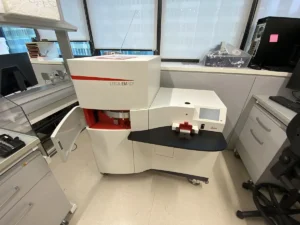
The Leica EM ICE is used for rapid cryofixation of biological samples by high-pressure freezing.
During the process, the specimen is exposed almost simultaneously to high pressure and rapid cooling with liquid nitrogen. High pressure suppresses ice-crystal formation and allows thicker specimens to be vitrified more effectively than is generally possible by conventional plunge freezing.
Main Applications
- Cryofixation of tissues
- Cryofixation of cell pellets
- Preservation of organoids and small organisms
- Freezing of concentrated cellular or microbial specimens
- Preservation of organelles and membrane systems
- Time-resolved freezing following light or electrical stimulation
- Preparation for freeze substitution and resin embedding
- Preparation for CEMOVIS
- Preparation of bulk specimens for cryo-FIB lift-out
- Correlative light and electron microscopy workflows
High-pressure freezing is particularly valuable when preservation of membranes, organelles, cytoskeletal elements, and other delicate cellular structures is required.
After freezing, specimens may be processed by freeze substitution using the AFS1 or AFS2, embedded in resin and sectioned for conventional TEM. Alternatively, they may be maintained in the vitrified state for cryogenic sectioning, cryo-FIB preparation, or cryo-electron microscopy.
The EM ICE uses a liquid-nitrogen-based, alcohol-free freezing principle and is designed to preserve biological ultrastructure in a close-to-native state. Leica recommends combining high-pressure freezing with downstream workflows such as freeze substitution, cellular electron microscopy, CLEM, and cryogenic analysis.