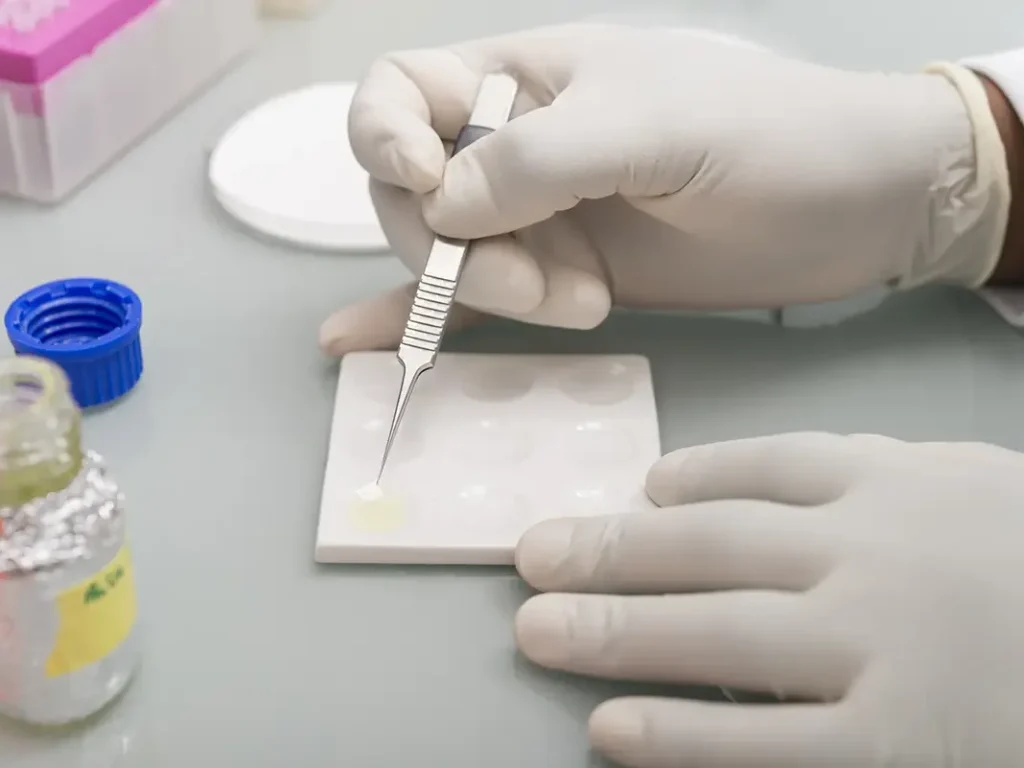
The negative staining method can provide valuable information about the visual appearance of a biological sample. It is commonly used to assess sample quality, including homogeneity, purity, aggregation state, concentration and oligomeric state. Although the sample is not maintained under fully native or physiological conditions, NS still offers useful insights into its behavior and stability. The acquired images can be used for morphological and statistical analyses (size/length distribution, decoration of nano-particles, viruses, etc), as well as for preliminary single-particle analysis (SPA). When sufficient sample homogeneity is observed, 2D classification or even a low-resolution 3D reconstruction can be performed. Quality control by NS is therefore strongly recommended (if not essential) before undertaking high-resolution structural studies by cryo-EM.
Guidelines for Sample Requirements
Security Requirements: Samples must comply with bio-safety level L1 standards (or L2 if fixed).
GMO Compliance: Samples must align with the relevant GMO regulations and statements.
Typically, we request approximately 30 µL of purified sample (e.g., after gel filtration or affinity chromatography) at a concentration of around 0.2 mg/mL. In addition, please provide 100 µL of the corresponding buffer to allow for potential dilution if necessary.
Whenever possible, the use of detergents or glycerol in the buffer should be avoided, as these components may interfere with sample preparation and image quality. The minimum molecular size that can generally be visualized is approximately 100 kDa.
After the experiment, samples can either be returned to the customer, if requested, or stored for up to two weeks before being safely discarded.
Main Contacts
Daphna Fenel / Guy Schoehn
(+33)(0) 457 428 581
Associated Equipment
The Tecnai T12 LaB6 120kV TEM equipped with an Orius 1000 camera (wide field) and a TVIPS F416 camera (4K x 4K) is primarily used for NS. Alternatively, the Tecnai F20 200 kV equipped with a CETA camera can also be used.